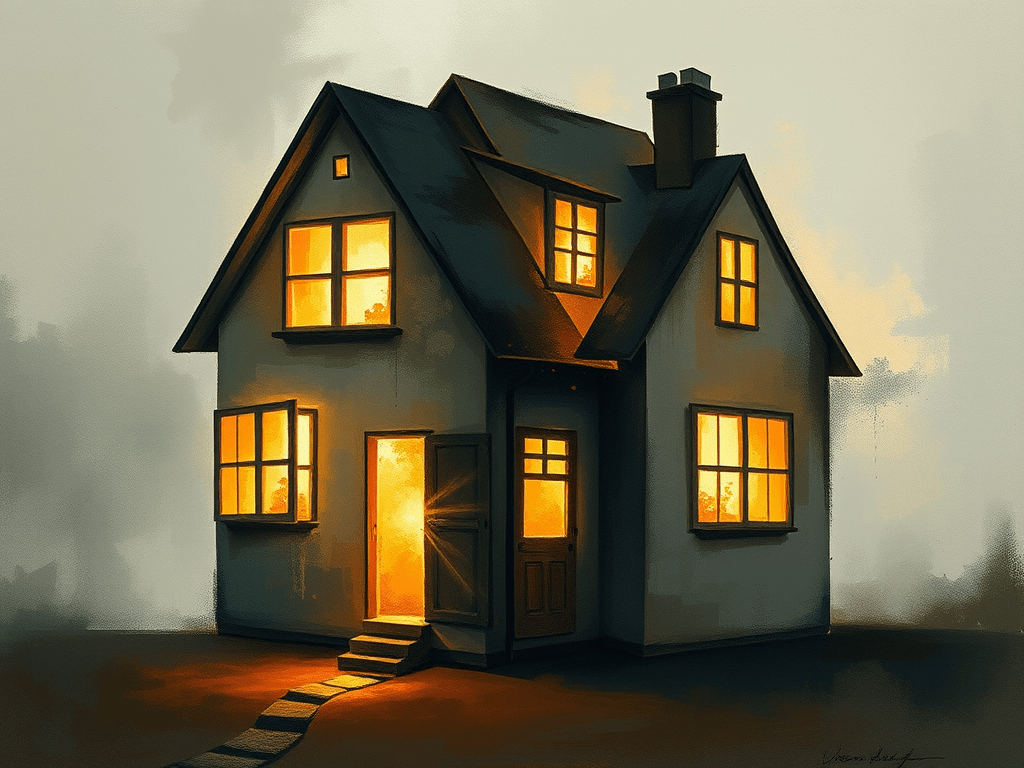
On How the Past Quietly Designs the House We Live In
There are moments when I react—not to what’s happening, but to something long gone.
A tone of voice, a phrase, a glance—
and suddenly I’m no longer responding to this moment,
but to a memory quietly rising from beneath it.
It took me years to realise that memory is not just a passive archive.
It is an architect.. It builds, designs, decorates..
Not the physical rooms we walk through—but the emotional spaces we inhabit.
We often believe we live in the present.
But if we look closer, much of what we feel, fear, or long for
has been structured by the past.
A childhood where affection came only after achievement.
A relationship where disagreement meant withdrawal.
A moment of public shame that taught us to stay quiet in rooms that mattered.
These experiences settle deep within us—
and over time, they begin to build.
They design invisible rooms of caution,
install emotional fire alarms,
and place locks on doors that once led to spontaneity or joy.
We start avoiding love—not because love is dangerous,
but because memory once taught us that love could leave.
We micromanage details—not because we’re controlling,
but because chaos once hurt us, and memory keeps us safe by staying vigilant.
We hesitate to speak our truth—not because we lack clarity,
but because a past silence protected us from punishment.
This is the architecture of memory.
Unseen, but deeply inhabited.
And unless we pause to walk through the house we’ve built,
we risk living in emotional blueprints we never consciously approved.
But here’s the truth that offers both power and responsibility:
Memory can be renovated.
We do not need to demolish our past—
but we can reinterpret it.
We can sit in the rooms of old pain and open the windows.
We can move the furniture.
We can add light where there was once only shadow.
To do that, we must first ask:
What are the memories I am still living inside, though the moment is long over?
What emotional architecture have I inherited, built, or absorbed unconsciously?
Does this structure still serve the person I am becoming?
Healing, I have come to believe, is not just emotional release.
It is also emotional reconstruction.
A slow, patient reworking of the inner blueprint—
so that the past becomes a foundation, not a prison.
Today, I revisit a few of those rooms.
Some still echo with voices I no longer need to obey.
Some hold beliefs I outgrew years ago.
Some are simply dusty with neglect.
And yet, each one holds a quiet potential—
not just to remind me who I was,
but to support who I’m becoming.
Because memory is not meant to be a master.
It is meant to be a map—
and we, its cartographers, always free to redraw the lines.
Letters for the Inner Journey by Pushkar

Whisper back, if the letter spoke to you.