On the Unspoken Distance Between Generations
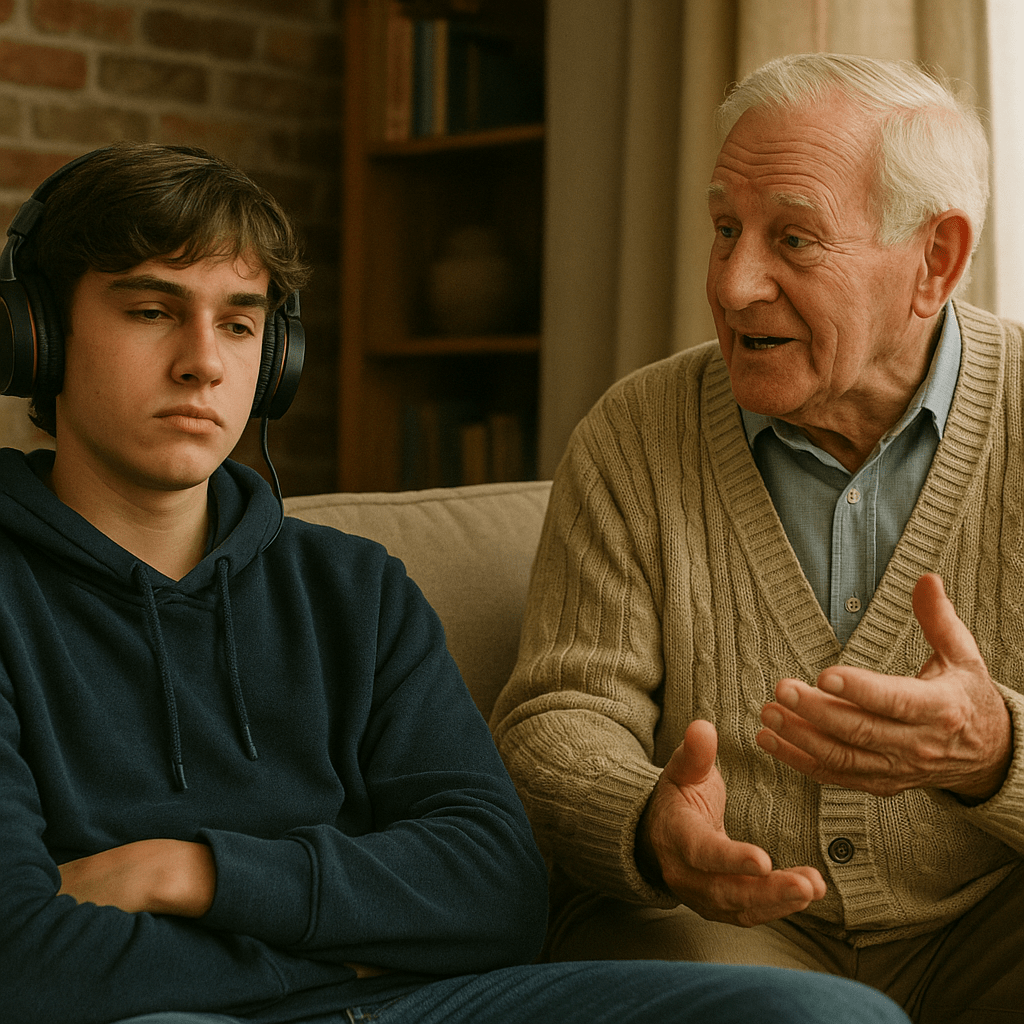
Some time ago, I visited a distant relative’s home for a family gathering. A young boy, no older than sixteen, sat slouched in a corner with his headphones on, half-listening to a conversation about “how things used to be.” – A man, in his seventies, his grandfather, I believe, was sharing stories about ration cards, handwritten letters, and bicycles with no gears.
The boy nodded occasionally, but the look in his eyes was far away, perhaps somewhere between a trending video and a text message thread. The old man spoke with nostalgia. The boy listened with obligation. Neither was wrong. But between them stretched a quiet, invisible canyon.
I’ve seen that canyon before. I’ve stood on both sides.
As a child, I questioned the ways of my elders—too slow, too fearful, too attached to convention. As an adult, I’ve occasionally winced at the choices of those younger ones —too distracted, too opinionated, too unwilling to listen. And yet, in moments of humility, I see the same patterns mirrored across decades. “The longing to be heard. The fear of becoming irrelevant. The struggle to belong to a rhythm not our own.”
The generation gap isn’t a new concept. But it remains poorly managed— more referenced than resolved. We define it as a difference in taste, values, technology, or thinking. But at its core, it’s something far simpler: a difference in pace and context.
We forget that every generation grows in a different soil. One knows scarcity, the other abundance. One built lives around duty, the other around discovery. One believes in obedience, the other in questioning. Neither is inherently better. They are simply shaped by different winds.
The danger lies not in the differences themselves, but in our refusal to stay curious about them.
What if we treated the generation gap not as a problem to fix, but as a conversation to continue?
What if we approached it with the same reverence we bring to translation—knowing that between two languages lies a world of misinterpretation and meaning?
Speaking across generations requires a slower tongue and a softer mind. It asks us to hold our judgments loosely and our questions gently. It invites us to listen—not to reply, but to understand.
So here’s a quiet practice:
Call someone older or younger than you. Don’t offer advice. Don’t correct. Just ask, “What’s been on your mind lately?” Let their world spill out in their own words. Let yours wait at the threshold.
Bridges are not built by people standing on their side of the river, shouting what they know.
They are built by those who meet in the middle—not to win, but to wonder.
And so I leave you with these questions:
When did I last truly listen to someone whose life rhythm is different from mine?
Am I willing to learn from a generation I don’t understand—or have I already made up my mind?
The silence between generations may never fully disappear.
But in that space, we can choose to build understanding—or let it echo with what we left unsaid.
Letters for the Inner Journey by Pushkar
