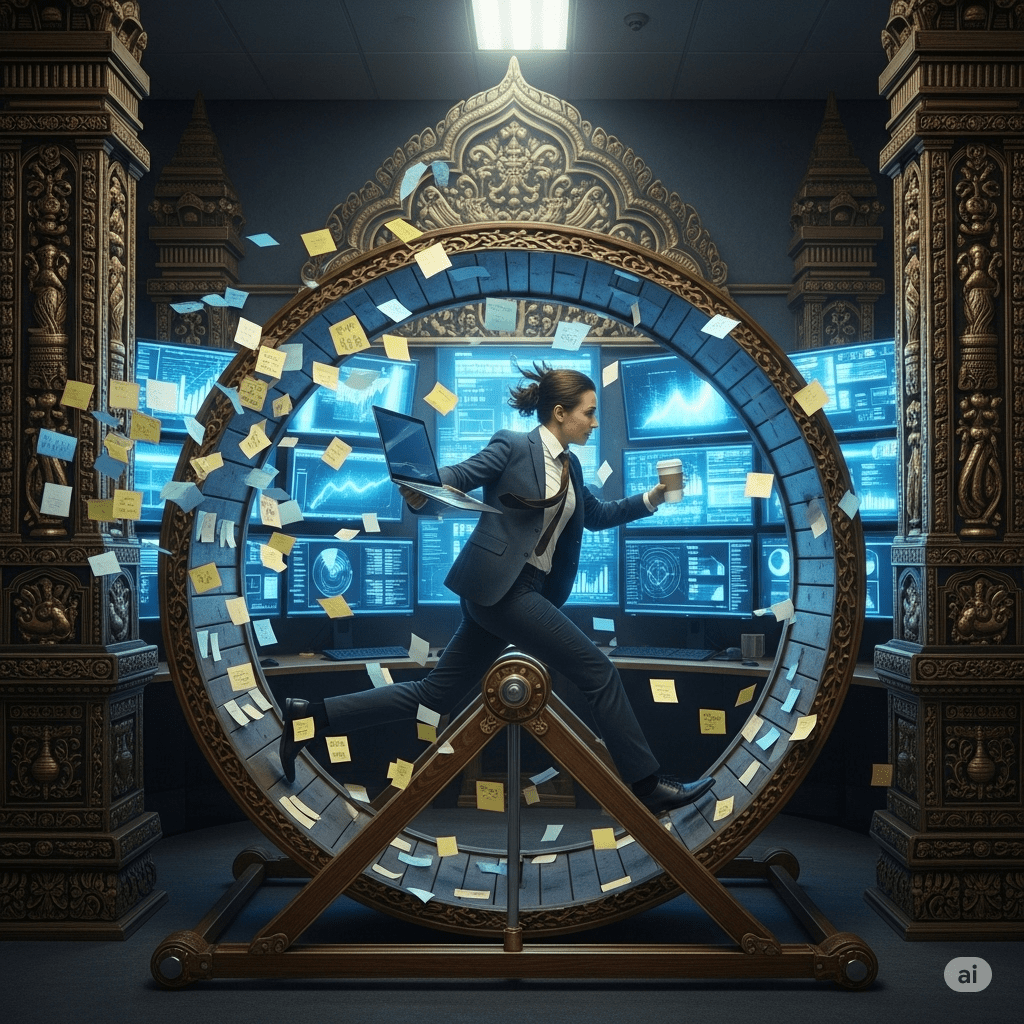
A reflection on moments when silence or idleness has been more rewarding than checklists.
The other day I caught myself rearranging the books on my shelf for the third time in a week. Not because they were untidy, but because I had this nagging sense that I shouldn’t just sit idle. Doing nothing felt… suspicious. So there I was, proudly convincing myself that moving a book from left to right was somehow “productive.”
It struck me in that moment: we have turned productivity into a religion. And like all religions, it comes with rituals (to-do lists, planners, time-tracking apps), commandments (“Thou shalt hustle”), and confessions (“I wasted the whole afternoon scrolling Instagram”).
When did busyness become a badge of honor? I remember, in my corporate days, people competed not over who had the most innovative idea but over who had the heaviest calendar. “I’ve got twelve meetings today” was code for “I am indispensable.” Being exhausted was worn like a medal. No one dared admit to taking an afternoon nap—it would sound like professional suicide.
But here’s the truth I’ve come to notice: constant productivity is less about achievement and more about addiction. We confuse motion with progress. We confuse noise with value. We confuse an overstuffed to-do list with a meaningful life.
And the addiction lingers even after you leave the corporate world. I see it in myself now. Retirement doesn’t necessarily free you from the productivity cult—it only changes the stage. Instead of performance reviews, we now create “personal projects” and hold ourselves accountable to invisible bosses in our heads. We try to justify our existence with gardening schedules, social obligations, or “self-improvement routines.” And heaven forbid we are found doing nothing.
But pause for a second—what is so scary about nothingness? Why do we dread stillness so much?
Perhaps because stillness confronts us with uncomfortable questions: Who am I if I’m not producing, performing, or achieving? If I stop being useful in the conventional sense, will I still matter? The cult of productivity thrives on this hidden fear—that we are only as good as our last output.
And yet, if we look deeper, life has never measured us by spreadsheets. Nature doesn’t hurry, but it gets everything done. A tree is not “lazy” when it stands silently through the afternoon sun. The ocean doesn’t apologise for ebbing before it flows again. Why, then, do we feel guilty for simply being?
I have come to realize that true productivity has less to do with quantity and more to do with quality. Not “How much did I do today?” but “Did what I do matter?” Some of my most valuable days have been the ones where I produced nothing tangible—just sat quietly, watched the rain, and felt a new clarity rise within me. Strangely, that silence has often birthed ideas, words, and insights that no amount of hustling could.
We need to reclaim rest, leisure, and reflection as legitimate forms of productivity. Not the kind that can be entered in a spreadsheet, but the kind that nourishes the spirit. A conversation with a friend, a walk without headphones, even an unapologetic nap—these moments renew us. They allow us to return to our work (whatever that may be) with creativity and compassion, intact.
Constant productivity may make us efficient machines, but it does not make us fulfilled humans. And perhaps that is the pivot modern society needs most urgently—to remember that the goal of life is not to produce endlessly but to live meaningfully.
So here’s my gentle proposal: the next time you catch yourself polishing an already polished shelf, pause. Ask yourself whether you’re doing it because it matters—or because you’re afraid of being seen as “idle.” And maybe, just maybe, let the dust gather a little while you sip tea and stare out of the window.
After all, sometimes the most productive thing you can do is nothing at all.
Letters for the Inner Journey by Pushkar
If something lingered in your heart while reading this letter, I’d love to hear from you. Leave a comment below..


Whisper back, if the letter spoke to you.